"When Did You See Her Last?" (All the Wrong Questions, 2) — Content Guide for Parents
Themes present
Not found
Content themes
Factual summary of themes present in this book. No opinion — just the facts.
Get the full theme breakdown in the app
Detailed evidence, confidence ratings, and source citations for every theme.
Download for iOSExample theme card
Religious themes
PRESENTContains references to prayer and church attendance. A minister character plays a supporting role in two chapters.
About this book
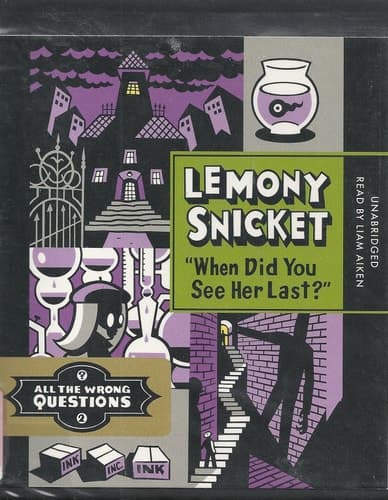
I should have asked the question "How could someone who was missing be in two places at once?" Instead, I asked the wrong question -- four wrong questions, more or less. This is the account of the second.
In the fading town of Stain'd-by-the-Sea, young apprentice Lemony Snicket has a new case to solve when he and his chaperone are hired to find a missing girl. Is the girl a runaway? Or was she kidnapped? Was she seen last at the grocery store? Or could she have stopped at the diner? Is it really any of your business? These are All The Wrong Questions.
Frequently asked questions
Is "When Did You See Her Last?" (All the Wrong Questions, 2) appropriate for a 7-year-old?
The book contains references to drugging with laudanum, a sleeping drug, which is mentioned as part of the plot but is not depicted in a graphic manner. This element is noted as not being significant in the overall narrative. While the book includes elements of mystery and some tension, there is no genuinely frightening content that would cause fear or distress. The narrative is described as playful even amidst the mystery.
Does "When Did You See Her Last?" (All the Wrong Questions, 2) have violence?
The book contains references to drugging with laudanum, a sleeping drug, which is mentioned as part of the plot but is not depicted in a graphic manner. This element is noted as not being significant in the overall narrative.
Does "When Did You See Her Last?" (All the Wrong Questions, 2) have scary content?
While the book includes elements of mystery and some tension, there is no genuinely frightening content that would cause fear or distress. The narrative is described as playful even amidst the mystery.
Does "When Did You See Her Last?" (All the Wrong Questions, 2) have religious themes?
No religious content in the book itself. The search results do not indicate any presence of religious practices, beliefs, or ceremonies in the narrative.
Does "When Did You See Her Last?" (All the Wrong Questions, 2) have racial/cultural content?
The search results do not indicate any explicit discussions of race or racism as a central theme in the book. The focus is on the mystery and characters rather than racial dynamics.
Does "When Did You See Her Last?" (All the Wrong Questions, 2) have profanity?
No profanity is indicated in the book. The search results do not mention any use of strong language or inappropriate terms.
Does "When Did You See Her Last?" (All the Wrong Questions, 2) have climate change?
There are implications regarding environmental themes, as the town of Stain'd-by-the-Sea is described as fading and possibly linked to environmental neglect. However, this is not a central theme and is more of a backdrop to the story.
Does "When Did You See Her Last?" (All the Wrong Questions, 2) have sexual identity?
No explicit sexual content is present in the book. The search results mention the presence of laudanum but do not indicate any sexual themes or content.
Does "When Did You See Her Last?" (All the Wrong Questions, 2) have gender roles?
The book features strong female characters, such as Moxie Mallahan and Cleo Knight, who are portrayed as capable and intelligent. This suggests a positive representation of gender roles, promoting female empowerment in a narrative primarily driven by a young male protagonist.
Does "When Did You See Her Last?" (All the Wrong Questions, 2) have lgbtq+ themes?
While there are mentions of possible interpretations regarding Lemony Snicket's character, such as implications of being a trans boy, these interpretations are not explicitly present in the book's narrative. The search results indicate speculation rather than confirmed LGBTQ+ content.