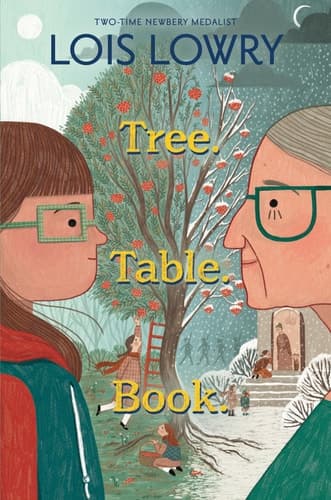
Tree. Table. Book — Content Guide for Parents
Themes present
Not found
Content themes
Factual summary of themes present in this book. No opinion — just the facts.
Get the full theme breakdown in the app
Detailed evidence, confidence ratings, and source citations for every theme.
Download for iOSExample theme card
Religious themes
PRESENTContains references to prayer and church attendance. A minister character plays a supporting role in two chapters.
About this book
From two-time Newbery medalist Lois Lowry comes this warm and resonant story of an unlikely friendship, which unfolds as a revelation on how we hold on to--and pass on--what matters most.
The latest compelling work from the master storyteller.
When precocious eleven-year-old Sophie sets out to save her elderly neighbor (who is also her dearest friend), her journey will take her through their familiar suburban landscape and then, steadily yet unexpectedly, deeper into a landscape of history and shared stories.
Everyone knows the two Sophies are best friends. One is in elementary school, and one is . . . well . . . in a little trouble of late. She's elderly, sure, but she's always been on her game, the best friend any girl struggling to fit in could ever have. The Sophies drink tea, have strong opinions about pretty much everything, and love each other dearly. Now it seems the elder Sophie is having memory problems, burning teakettles, and forgetting just about everything. It looks like her son is going to come and get her and steal her away forever. Young Sophie isn't having that. Not one bit. So she sets out to help elder Sophie's memory, with the aid of her neighborhood friends Ralphie and Oliver. But when she opens the floodgates of elder Sophie's memories, she winds up listening to stories that will illustrate just how much there is to know about her dear friend, stories of war, hunger, cruelty, and ultimately love.
Frequently asked questions
Is Tree. Table. Book appropriate for a 7-year-old?
The narrative includes references to the Nazi occupation of a Polish village during World War II, which implies violent historical events, though it is not described graphically. The book does not contain genuinely frightening content. It addresses themes of dementia and friendship, which may evoke emotional responses but are not scary.
Does Tree. Table. Book have violence?
The narrative includes references to the Nazi occupation of a Polish village during World War II, which implies violent historical events, though it is not described graphically.
Does Tree. Table. Book have scary content?
The book does not contain genuinely frightening content. It addresses themes of dementia and friendship, which may evoke emotional responses but are not scary.
Does Tree. Table. Book have religious themes?
The book includes themes related to the Holocaust, as the elder Sophie escaped it by hiding with a Christian family. This implies a connection to Christian beliefs and the impact of faith during that time.
Does Tree. Table. Book have racial/cultural content?
While the book features characters of different backgrounds, race is not a central theme or plot point. The focus is on friendship and personal history rather than racial dynamics.
Does Tree. Table. Book have profanity?
The book contains some mild profanity, including words marked with asterisks, such as 'D*** it all!' and terms like 'boobies'.
Does Tree. Table. Book have climate change?
There are no themes related to climate or environmental issues in the book. The story centers on personal relationships and historical reflections.
Does Tree. Table. Book have sexual identity?
No sexual content is present in the book. References to relationships are focused on friendship and do not include romantic or sexual themes.
Does Tree. Table. Book have gender roles?
The book features an intergenerational friendship but does not actively discuss or critique gender roles. The narrative focuses on the relationship between the two main characters rather than gender expectations.
Does Tree. Table. Book have lgbtq+ themes?
No LGBTQ+ themes explicitly present in the book. While one review mentions a reference to a same-sex couple, it does not indicate that this is a central theme or significant aspect of the story.