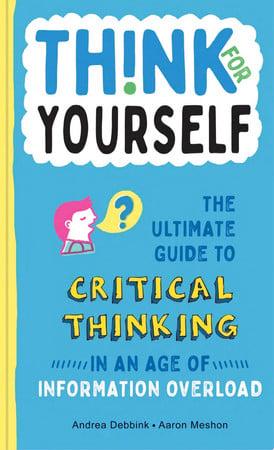
Think for Yourself The Ultimate Guide to Critical Thinking in an Age of Information Overload — Content Guide for Parents
Found in this book
- ViolenceBrief
- Race & cultureBrief
Not found
- Scary content
- Religion
- Climate
- Sexual content
- Gender roles
Couldn't confirm
- Profanity
- Gender & orientation
- Profanity: No source reports on the book's language, and no word-search source is available.
- Gender & orientation: The sources describe the book's structure and topics but do not mention LGBTQ+ content either way.
Content themes
Factual summary of themes present in this book. No opinion — just the facts.
Get the full theme breakdown in the app
Summaries and source quotes for every theme.
Download for iOSExample theme card
Religion
PRESENTContains references to prayer and church attendance. A minister character plays a supporting role in two chapters.
About this book
Middle school is a time of change, when things begin to look different and assumptions start to be questioned, and today more than ever it’s tough to know what to believe.
This unique and timely book won’t tell you what to think—that’s up to you!—but it will show you how to think more deeply about your own life and current events. Covering a wide range of subjects affecting the world today, including human and animal rights, social media, cyber bullying, the refugee crisis, and more, THINK FOR YOURSELF will help you to learn how to ask questions, analyze evidence, and use logic to draw conclusions, so you can solve problems and make smart decisions.
Each chapter of the book covers one key step in the critical thinking process, and includes a real-world example to help convey the importance and relevance of every step:
Ask Questions: If you want to be a critical thinker, it helps to be curious. It’s normal to wonder about the world around us. Some questions are big, and some are small. Sometimes questions can spark debate and argument. All critical thinking starts with at least one question.
Gather Evidence: First, find information—from making observations to interviewing experts to researching a topic online or in books. Then make connections and draw conclusions.
Evaluating Evidence: Smart thinkers evaluate the importance, accuracy and relevancy of the information they gather.
Getting Curious: Consider other points of view, examine your own point of view, understand the power of emotion, and practice empathy.
Draw Conclusions: The final step in the critical thinking process, this is based on reason and evidence. Revisit your original question, review the evidence and what you’ve learned, and consider your values. And remember: critical thinking doesn’t stop when you’ve reached a decision. Learn how to discuss and debate other points of view. Then keep growing. Sometimes you might change your mind—that’s OK, too!
Featuring profiles of real-life inspiring young critical thinkers from around the world, checklists, quizzes, and activities, THINK FOR YOURSELF is a clever and fun illustrated guide that teaches middle schoolers that even young people can make a difference in the world just by thinking smart and understanding.
INCLUDES:
- Your Turn: activities to help connect ideas to readers’ lives
- Quizzes
- Profiles of inspiring young critical thinkers
- A Reading List for Young Thinkers
- Teacher's guides
- Plus a table of contents, index, and glossary for easy searching
Frequently asked questions
Is Think for Yourself The Ultimate Guide to Critical Thinking in an Age of Information Overload appropriate for a 7-year-old?
Gun violence appears among the real-world issues the book uses as examples; the sources give no detail on how it is shown. The book uses the refugee crisis and stereotypes as topics for practising critical thinking, but the sources do not say how much space they get.
Does Think for Yourself The Ultimate Guide to Critical Thinking in an Age of Information Overload have violence?
Found (Brief): Gun violence appears among the real-world issues the book uses as examples; the sources give no detail on how it is shown.
Does Think for Yourself The Ultimate Guide to Critical Thinking in an Age of Information Overload have scary content?
Not found in the sources we checked.
Does Think for Yourself The Ultimate Guide to Critical Thinking in an Age of Information Overload have religion?
Not found in the sources we checked.
Does Think for Yourself The Ultimate Guide to Critical Thinking in an Age of Information Overload have race & culture?
Found (Brief): The book uses the refugee crisis and stereotypes as topics for practising critical thinking, but the sources do not say how much space they get.
Does Think for Yourself The Ultimate Guide to Critical Thinking in an Age of Information Overload have profanity?
Couldn't confirm: No source reports on the book's language, and no word-search source is available.
Does Think for Yourself The Ultimate Guide to Critical Thinking in an Age of Information Overload have climate?
Not found in the sources we checked.
Does Think for Yourself The Ultimate Guide to Critical Thinking in an Age of Information Overload have sexual content?
Not found in the sources we checked.
Does Think for Yourself The Ultimate Guide to Critical Thinking in an Age of Information Overload have gender roles?
Not found in the sources we checked.
Does Think for Yourself The Ultimate Guide to Critical Thinking in an Age of Information Overload have gender & orientation?
Couldn't confirm: The sources describe the book's structure and topics but do not mention LGBTQ+ content either way.