The Seventh Most Important Thing — Content Guide for Parents
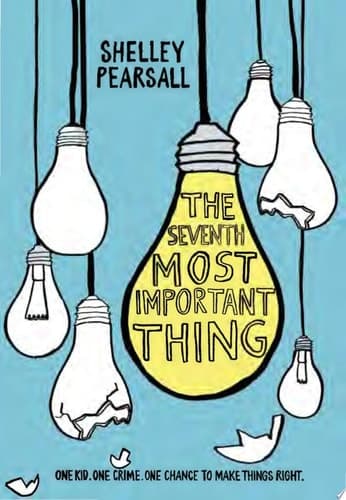
Themes present
Not found
Content themes
Factual summary of themes present in this book. No opinion — just the facts.
Get the full theme breakdown in the app
Detailed evidence, confidence ratings, and source citations for every theme.
Download for iOSExample theme card
Religious themes
PRESENTContains references to prayer and church attendance. A minister character plays a supporting role in two chapters.
About this book
NOMINATED FOR 16 STATE AWARDS!
AN ALA NOTABLE BOOK
AN ILA TEACHERS CHOICE
A KIRKUS REVIEWS BEST BOOK OF THE YEAR
Arthur T. Owens grabbed a brick and hurled it at the trash picker. Arthur had his reasons, and the brick hit the Junk Man in the arm, not the head. But none of that matters to the judge—he is ready to send Arthur to juvie forever. Amazingly, it’s the Junk Man himself who offers an alternative: 120 hours of community service . . . working for him.
Arthur is given a rickety shopping cart and a list of the Seven Most Important Things: glass bottles, foil, cardboard, pieces of wood, lightbulbs, coffee cans, and mirrors. He can’t believe it—is he really supposed to rummage through people’s trash? But it isn’t long before Arthur realizes there’s more to the Junk Man than meets the eye, and the “trash” he’s collecting is being transformed into something more precious than anyone could imagine. . . .
Inspired by the work of folk artist James Hampton, Shelley Pearsall has crafted an affecting and redemptive novel about discovering what shines within us all, even when life seems full of darkness.
“A moving exploration of how there is often so much more than meets the eye.” —Booklist, starred review
“There are so many things to love about this book. Remarkable.” —The Christian Science Monitor
Frequently asked questions
Is The Seventh Most Important Thing appropriate for a 7-year-old?
The book follows a 13-year-old boy named Arthur who must confront the consequences of a violent crime he committed against an elderly man known as the Junk Man. This theme of violence and its repercussions is central to the story. No genuinely frightening content is present in the book. The narrative focuses on themes of grief and redemption rather than horror or fear-inducing elements.
Does The Seventh Most Important Thing have violence?
The book follows a 13-year-old boy named Arthur who must confront the consequences of a violent crime he committed against an elderly man known as the Junk Man. This theme of violence and its repercussions is central to the story.
Does The Seventh Most Important Thing have scary content?
No genuinely frightening content is present in the book. The narrative focuses on themes of grief and redemption rather than horror or fear-inducing elements.
Does The Seventh Most Important Thing have religious themes?
No religious content is present in the book itself. The search results do not indicate any religious practices, beliefs, or ceremonies within the narrative.
Does The Seventh Most Important Thing have racial/cultural content?
Race is not a central theme or plot point in the book. The narrative centers on personal redemption and the transformative power of art rather than racial issues.
Does The Seventh Most Important Thing have profanity?
No profanity is mentioned in the book. The search results do not indicate any use of inappropriate language within the narrative.
Does The Seventh Most Important Thing have climate change?
No climate themes are present in the book. The narrative does not address environmental issues or activism.
Does The Seventh Most Important Thing have sexual identity?
No sexual content is present in the book. The search results do not indicate any explicit sexual themes or discussions within the narrative.
Does The Seventh Most Important Thing have gender roles?
The book does not actively discuss or critique gender roles. It focuses on the protagonist's journey and the impact of art rather than gender dynamics.
Does The Seventh Most Important Thing have lgbtq+ themes?
No LGBTQ+ themes or characters are mentioned in the book's narrative. The search results do not provide any specific references to LGBTQ+ content within 'The Seventh Most Important Thing'.