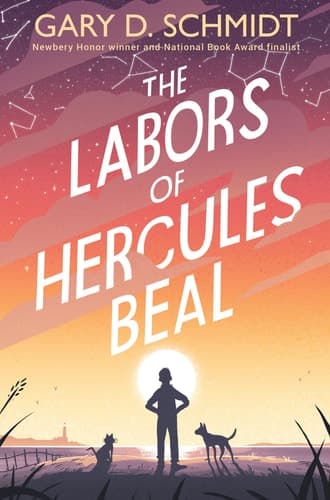
The Labors of Hercules Beal — Content Guide for Parents
Themes present
Not found
Content themes
Factual summary of themes present in this book. No opinion — just the facts.
Get the full theme breakdown in the app
Detailed evidence, confidence ratings, and source citations for every theme.
Download for iOSExample theme card
Religious themes
PRESENTContains references to prayer and church attendance. A minister character plays a supporting role in two chapters.
About this book
From award-winning author Gary D. Schmidt, a warm and witty novel in the tradition of The Wednesday Wars, in which a seventh grader has to figure out how to fulfill a seemingly impossible school assignment--and learns about friendship, community, and himself along the way.
Herc Beal knows who he's named after--a mythical hero--but he's no superhero. He's the smallest kid in his class. So when his homeroom teacher at his new middle school gives him the assignment of duplicating the mythical Hercules's amazing feats in real life, he's skeptical. After all, there are no Nemean Lions on Cape Cod--and not a single Hydra in sight.
Missing his parents terribly and wishing his older brother wasn't working all the time, Herc figures out how to take his first steps along the road that the great Hercules himself once walked. Soon, new friends, human and animal, are helping him. And though his mythical role model performed his twelve labors by himself, Herc begins to see that he may not have to go it alone.
Frequently asked questions
Is The Labors of Hercules Beal appropriate for a 7-year-old?
The book contains instances of violence, including a broken nose from a bloody fistfight and car crashes. It also addresses themes of parental death, which contribute to the overall tone of the story. While the book includes themes of loss and some intense situations, it does not contain genuinely frightening content that would cause fear or distress. The narrative focuses more on personal growth and challenges.
Does The Labors of Hercules Beal have violence?
The book contains instances of violence, including a broken nose from a bloody fistfight and car crashes. It also addresses themes of parental death, which contribute to the overall tone of the story.
Does The Labors of Hercules Beal have scary content?
While the book includes themes of loss and some intense situations, it does not contain genuinely frightening content that would cause fear or distress. The narrative focuses more on personal growth and challenges.
Does The Labors of Hercules Beal have religious themes?
No religious practices, beliefs, or ceremonies are mentioned in the book itself. While the author is described as a practicing Christian, this aspect of his personal background does not translate into the book's narrative.
Does The Labors of Hercules Beal have racial/cultural content?
The book does not explicitly address race as a central theme or plot point. The main characters are described as reading White, but this is not a focus of the narrative.
Does The Labors of Hercules Beal have profanity?
The book includes mild profanity, such as the word 'jackass' and other mild language. This is noted as part of the character's dialogue but is not excessive.
Does The Labors of Hercules Beal have climate change?
The story includes elements related to environmental themes, particularly through the setting of the Cape Cod Academy for Environmental Sciences, where the protagonist is sent to school. This suggests a focus on environmental awareness and responsibility.
Does The Labors of Hercules Beal have sexual identity?
There is no sexual content in the book. The only language noted is mild, including the term 'jackass', but this does not constitute sexual content.
Does The Labors of Hercules Beal have gender roles?
The book does not actively discuss or critique gender roles. It focuses on the protagonist's personal journey and relationships rather than on traditional or modern gender expectations.
Does The Labors of Hercules Beal have lgbtq+ themes?
The book features themes of transgender friendship and the right to be oneself, indicating a positive representation of LGBTQ+ issues. It is described as a touching and humorous story that explores these themes within the context of a middle-grade novel.