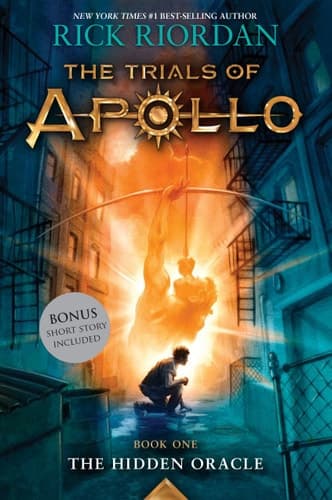
The Hidden Oracle (Trials of Apollo, Book One) — Content Guide for Parents
Themes present
Not found
Content themes
Factual summary of themes present in this book. No opinion — just the facts.
Get the full theme breakdown in the app
Detailed evidence, confidence ratings, and source citations for every theme.
Download for iOSExample theme card
Religious themes
PRESENTContains references to prayer and church attendance. A minister character plays a supporting role in two chapters.
About this book
By making him human.
After angering his father Zeus, the god Apollo is cast down from Olympus. Weak and disoriented, he lands in New York City as a regular teenage boy. Now, without his godly powers, the four-thousand-year-old deity must learn to survive in the modern world until he can somehow find a way to regain Zeus's favor.
But Apollo has many enemies-gods, monsters, and mortals who would love to see the former Olympian permanently destroyed. Apollo needs help, and he can think of only one place to go . . . an enclave of modern demigods known as Camp Half-Blood.
Also included, a bonus short story: "Percy Jackson and the Singer of Apollo"
Frequently asked questions
Is The Hidden Oracle (Trials of Apollo, Book One) appropriate for a 7-year-old?
The book contains several violent scenes, including fights against mythological creatures and humans, resulting in injuries such as a broken nose. There are also references to past deaths and violent events in mythology. The book features some suspenseful moments and mythical creatures, but there is no genuinely frightening content that would cause fear or distress in young readers.
Does The Hidden Oracle (Trials of Apollo, Book One) have violence?
The book contains several violent scenes, including fights against mythological creatures and humans, resulting in injuries such as a broken nose. There are also references to past deaths and violent events in mythology.
Does The Hidden Oracle (Trials of Apollo, Book One) have scary content?
The book features some suspenseful moments and mythical creatures, but there is no genuinely frightening content that would cause fear or distress in young readers.
Does The Hidden Oracle (Trials of Apollo, Book One) have religious themes?
The narrative includes references to Greek mythology, with Apollo reflecting on his past as a god and the influence he had on various myths. It also touches on historical events involving the persecution of Christians during Roman times, suggesting a critique of historical religious practices.
Does The Hidden Oracle (Trials of Apollo, Book One) have racial/cultural content?
The book includes diverse characters, with descriptions of demigods of various racial backgrounds, including African and Asian heritage. This diversity is presented positively, contributing to the inclusivity of the narrative.
Does The Hidden Oracle (Trials of Apollo, Book One) have profanity?
No profanity is mentioned in the book. The language used is appropriate for the target age group, focusing on humor and adventure without the inclusion of strong language.
Does The Hidden Oracle (Trials of Apollo, Book One) have climate change?
There are no references to climate themes or environmental issues in the book. The focus remains on mythology and character development rather than contemporary climate discussions.
Does The Hidden Oracle (Trials of Apollo, Book One) have sexual identity?
While the book does not contain explicit sexual content, it acknowledges Apollo's past relationships with both men and women, indicating his bisexuality. The narrative does not focus on sexual acts but rather on the characters' identities.
Does The Hidden Oracle (Trials of Apollo, Book One) have gender roles?
The book features a strong female character, Meg, who is portrayed as capable and assertive. However, some critiques suggest that her character may fit into a stereotypical 'strong female character' trope without deeper development.
Does The Hidden Oracle (Trials of Apollo, Book One) have lgbtq+ themes?
The book features Apollo, who is bisexual and openly supports his son Will's relationship with another boy, Nico. This representation is highlighted throughout the narrative, showcasing a positive portrayal of LGBTQ+ themes.