Rules of Attraction — Content Guide for Parents
Themes present
Not found
Content themes
Factual summary of themes present in this book. No opinion — just the facts.
Get the full theme breakdown in the app
Detailed evidence, confidence ratings, and source citations for every theme.
Download for iOSExample theme card
Religious themes
PRESENTContains references to prayer and church attendance. A minister character plays a supporting role in two chapters.
About this book
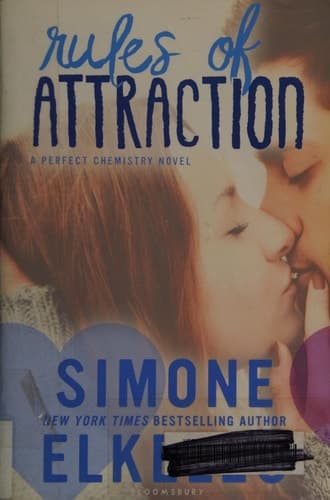
In the second book in Simone Elkeles' New York Times bestselling YA contemporary romance series, bad boy Carlos Fuentes and good girl Kiara Westford don't mean to fall for each other . . . but in the game of love, there are no rules.
Carlos Fuentes feels betrayed when the big brother he idolized, Alex, trades in a life as a gang member for a future with his girlfriend. Even worse, Alex forces Carlos to join him on the straight and narrow path in the United States. Trouble is, Carlos just wants to live on the edge. And ties to his gang in Mexico aren't easy to break, even when Carlos is hundreds of miles away . . .
Living with one of Alex's college professors in the Colorado suburbs, Carlos feels completely out of place. He's even more thrown by his sudden feelings for the professor's daughter, Kiara. She's nothing like the wild girls he's usually drawn to. But Carlos and Kiara soon discover that in matters of the heart, the rules of attraction might overpower the dangers and differences keeping them apart.
Don't miss any of these other books from New York Times bestselling author Simone Elkeles:
The Perfect Chemistry Trilogy
Perfect Chemistry
Rules of Attraction
Chain Reaction
Better Than Perfect
Frequently asked questions
Is Rules of Attraction appropriate for a 7-year-old?
The book contains references to peril and explicit violence, including a graphic suicide scene, indicating a moderate level of violence in the narrative. No scary content detected in the search results; the focus is on relationships and personal struggles rather than horror elements.
Does Rules of Attraction have violence?
The book contains references to peril and explicit violence, including a graphic suicide scene, indicating a moderate level of violence in the narrative.
Does Rules of Attraction have scary content?
No scary content detected in the search results; the focus is on relationships and personal struggles rather than horror elements.
Does Rules of Attraction have religious themes?
No religious content or themes detected in the book's narrative based on the search results.
Does Rules of Attraction have racial/cultural content?
The story involves a Latino character, Carlos, who feels out of place in a new environment and deals with social differences in his romantic interest with Kiara, indicating themes of cultural identity and social dynamics.
Does Rules of Attraction have profanity?
The narrative includes strong and frequent profanity, with terms like 'f--k' and 's--t' appearing in dialogue, indicating a high level of coarse language.
Does Rules of Attraction have climate change?
No climate themes or environmental issues detected in the book's narrative based on the search results.
Does Rules of Attraction have sexual identity?
The book features extremely graphic and explicit sexual situations, including discussions of sexual tension and encounters between characters, which are central to the plot.
Does Rules of Attraction have gender roles?
No explicit traditional or modern gender roles detected in the narrative based on the search results.
Does Rules of Attraction have lgbtq+ themes?
The narrative includes characters with LGBTQ+ themes, such as Stuart who has feelings for Paul and Mitchell who is trying to forget his homosexual past with Paul. This suggests a portrayal of bisexuality and same-sex attraction as part of the story's dynamics.