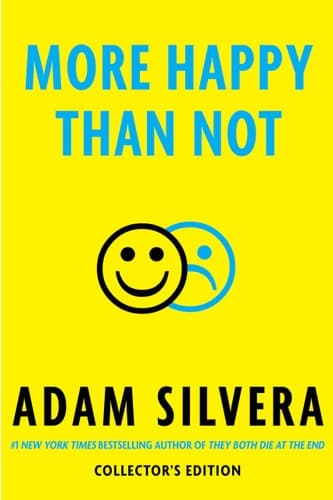
More Happy Than Not Collector's Edition — Content Guide for Parents
Themes present
Not found
Content themes
Factual summary of themes present in this book. No opinion — just the facts.
Get the full theme breakdown in the app
Detailed evidence, confidence ratings, and source citations for every theme.
Download for iOSExample theme card
Religious themes
PRESENTContains references to prayer and church attendance. A minister character plays a supporting role in two chapters.
About this book
Exclusive content includes: An interview between author Adam Silvera and the real-life inspiration for Thomas, scanned pages from the novel's first outline with annotations, and new book club questions.
In his twisty, gritty, profoundly moving New York Times bestselling-debut--also called "mandatory reading" and selected as an Editors' Choice by the New York Times—Adam Silvera brings to life a charged, dangerous near-future summer in the Bronx.
In the months after his father's suicide, it's been tough for sixteen-year-old Aaron Soto to find happiness again—but he's still gunning for it. With the support of his girlfriend Genevieve and his overworked mom, he's slowly remembering what that might feel like. But grief and the smile-shaped scar on his wrist prevent him from forgetting completely.
When Genevieve leaves for a couple of weeks, Aaron spends all his time hanging out with this new guy, Thomas. Aaron's crew notices, and they're not exactly thrilled. But Aaron can't deny the happiness Thomas brings or how Thomas makes him feel safe from himself, despite the tensions their friendship is stirring with his girlfriend and friends. Since Aaron can't stay away from Thomas or turn off his newfound feelings for him, he considers turning to the Leteo Institute's revolutionary memory-alteration procedure to straighten himself out, even if it means forgetting who he truly is.
Why does happiness have to be so hard?
Frequently asked questions
Is More Happy Than Not Collector's Edition appropriate for a 7-year-old?
The book includes a scene where Aaron is beaten up by his friends after being seen hugging another boy, which is a significant act of violence that impacts the plot and character development. No content described as scary or frightening was found in the search results.
Does More Happy Than Not Collector's Edition have violence?
The book includes a scene where Aaron is beaten up by his friends after being seen hugging another boy, which is a significant act of violence that impacts the plot and character development.
Does More Happy Than Not Collector's Edition have scary content?
No content described as scary or frightening was found in the search results.
Does More Happy Than Not Collector's Edition have religious themes?
No religious content or themes detected in the search results.
Does More Happy Than Not Collector's Edition have racial/cultural content?
The book features a diverse cast of characters and addresses issues related to race and identity, particularly through the experiences of Aaron, a gay Hispanic teenager from the Bronx.
Does More Happy Than Not Collector's Edition have profanity?
The dialogue in the book includes strong language, with characters using terms like 'f--k' and 's--t', reflecting the realistic speech of teenagers in the Bronx.
Does More Happy Than Not Collector's Edition have climate change?
No climate-related themes or content were detected in the search results.
Does More Happy Than Not Collector's Edition have sexual identity?
The narrative contains references to sexual activity, including discussions of first times and illicit hookups. It addresses the complexities of teenage sexual experiences within the context of Aaron's journey of self-discovery.
Does More Happy Than Not Collector's Edition have gender roles?
No specific themes regarding traditional or modern gender roles were identified in the search results.
Does More Happy Than Not Collector's Edition have lgbtq+ themes?
The story centers on Aaron, a teenager who grapples with his sexual identity, questioning whether he is straight, bisexual, or gay. The narrative explores themes of self-acceptance and the desire to suppress one's true identity, particularly through the concept of a memory-wiping procedure meant to erase his knowledge of being gay.