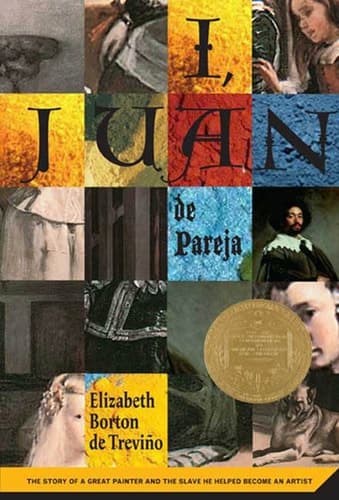
I, Juan de Pareja The Story of a Great Painter and the Slave He Helped Become a Great Artist — Content Guide for Parents
Themes present
Not found
Content themes
Factual summary of themes present in this book. No opinion — just the facts.
Get the full theme breakdown in the app
Detailed evidence, confidence ratings, and source citations for every theme.
Download for iOSExample theme card
Religious themes
PRESENTContains references to prayer and church attendance. A minister character plays a supporting role in two chapters.
About this book
When the great Velázquez was painting his masterpieces at the Spanish court in the seventeenth century, his colors were expertly mixed and his canvases carefully prepared by his slave, Juan de Pareja. In a vibrant novel which depicts both the beauty and the cruelty of the time and place, Elizabeth Borton de Treviño tells the story of Juan, who was born a slave and died an accomplished and respected artist.
Upon the death of his indulgent mistress in Seville, Juan de Pareja was uprooted from the only home he had known and placed in the charge of a vicious gypsy muleteer to be sent north to his mistress's nephew and heir, Diego Velázquez, who recognized at once the intelligence and gentle breeding which were to make Juan his indispensable assistant and companion—and his lifelong friend.
Through Juan's eyes the reader sees Velázquez's delightful family, his working habits and the character of the man, his relations with the shy yet devoted King Philip IV and with his fellow painters, Rubens and Murillo, the climate and customs of Spanish court life. When Velázquez discovers that he and Juan share a love for the art which is his very life, the painter proves his friendship in the most incredible fashion, for in those days it was forbidden by law for slaves to learn or practice the arts. Through the hardships of voyages to Italy, through the illnesses of Velázquez, Juan de Pareja loyally serves until the death of the painter in 1660.
I, Juan de Pareja is the winner of the 1966 Newbery Medal.
Latino Interest.
Frequently asked questions
Is I, Juan de Pareja The Story of a Great Painter and the Slave He Helped Become a Great Artist appropriate for a 7-year-old?
The book depicts the cruelty of slavery and societal injustices but does not contain explicit violence between characters. It focuses on the life and struggles of Juan de Pareja as a slave and artist. No genuinely frightening content is present in the book. While it addresses the harsh realities of slavery, it does so in a way that is suitable for children and does not include horror themes.
Does I, Juan de Pareja The Story of a Great Painter and the Slave He Helped Become a Great Artist have violence?
The book depicts the cruelty of slavery and societal injustices but does not contain explicit violence between characters. It focuses on the life and struggles of Juan de Pareja as a slave and artist.
Does I, Juan de Pareja The Story of a Great Painter and the Slave He Helped Become a Great Artist have scary content?
No genuinely frightening content is present in the book. While it addresses the harsh realities of slavery, it does so in a way that is suitable for children and does not include horror themes.
Does I, Juan de Pareja The Story of a Great Painter and the Slave He Helped Become a Great Artist have religious themes?
No religious content is present in the book itself. The narrative focuses on the historical context of slavery and art in 17th century Spain without discussing religious practices or beliefs.
Does I, Juan de Pareja The Story of a Great Painter and the Slave He Helped Become a Great Artist have racial/cultural content?
The book explores themes of race through the experiences of Juan de Pareja, a Black slave, and his interactions with Velázquez, highlighting racial dynamics and societal attitudes of the time. It reflects on the struggles and achievements of a Black artist in a predominantly white society.
Does I, Juan de Pareja The Story of a Great Painter and the Slave He Helped Become a Great Artist have profanity?
No profanity is present in the book. The language used is appropriate for a children's audience, focusing on historical narrative and character development.
Does I, Juan de Pareja The Story of a Great Painter and the Slave He Helped Become a Great Artist have climate change?
No climate themes are present in the book. The narrative does not address environmental issues or activism, focusing instead on historical and artistic themes.
Does I, Juan de Pareja The Story of a Great Painter and the Slave He Helped Become a Great Artist have sexual identity?
No sexual content is present in the book. The narrative centers on Juan's artistic journey and his relationship with Velázquez, with no mention of sexual themes.
Does I, Juan de Pareja The Story of a Great Painter and the Slave He Helped Become a Great Artist have gender roles?
The book does not actively discuss or critique gender roles. It primarily focuses on the relationship between Juan and Velázquez and does not center on gender dynamics.
Does I, Juan de Pareja The Story of a Great Painter and the Slave He Helped Become a Great Artist have lgbtq+ themes?
No LGBTQ+ themes or characters are mentioned in the book's narrative. The focus is on the life of Juan de Pareja, a slave and artist, and his relationship with the painter Velázquez.