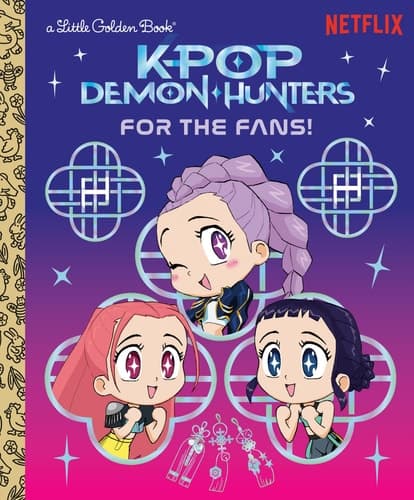
For the Fans! (KPop Demon Hunters) — Content Guide for Parents
Themes present
Not found
Content themes
Factual summary of themes present in this book. No opinion — just the facts.
Get the full theme breakdown in the app
Detailed evidence, confidence ratings, and source citations for every theme.
Download for iOSExample theme card
Religious themes
PRESENTContains references to prayer and church attendance. A minister character plays a supporting role in two chapters.
About this book
Rumi, Mira, and Zoey are pop stars by day and Hunters by night! Meet them along with Saja Boys, the hottest new demon-boy band on the scene, Derpy Tiger, Sussie, and more beloved characters from KPop Demon Hunters in this Little Golden Book. Featuring adorable, stylized artwork, this must-have, official storybook will entertain and excite fans of all ages. Happy fans, happy Honmoon!
Little Golden Books enjoy nearly 100% consumer recognition. They feature beloved classics, hot licenses, and new original stories . . . the classics of tomorrow.
Frequently asked questions
Is For the Fans! (KPop Demon Hunters) appropriate for a 7-year-old?
The story features action-comedy elements where main characters engage in fights and are attacked by demons, indicating a moderate level of violence appropriate for the intended audience. The book includes creepy demons and action sequences that could be frightening for younger readers, aligning with typical themes found in action-comedy animations.
Does For the Fans! (KPop Demon Hunters) have violence?
The story features action-comedy elements where main characters engage in fights and are attacked by demons, indicating a moderate level of violence appropriate for the intended audience.
Does For the Fans! (KPop Demon Hunters) have scary content?
The book includes creepy demons and action sequences that could be frightening for younger readers, aligning with typical themes found in action-comedy animations.
Does For the Fans! (KPop Demon Hunters) have religious themes?
The narrative includes themes that reflect Christian values, particularly in the context of redemption and overcoming shame. This is highlighted through character arcs that resonate with Augustinian anthropology, suggesting a critique of exclusionary practices in religion.
Does For the Fans! (KPop Demon Hunters) have racial/cultural content?
While the story features characters from diverse backgrounds, race is not a central theme or plot point. The narrative primarily focuses on the characters' adventures and interactions.
Does For the Fans! (KPop Demon Hunters) have profanity?
There is mention of mild profanity in the context of character dialogue, specifically a single curse word used in a humorous context, which is not pervasive throughout the narrative.
Does For the Fans! (KPop Demon Hunters) have climate change?
There are no themes related to climate activism or environmentalism present in the book. The focus remains on the characters' adventures and their roles as demon hunters.
Does For the Fans! (KPop Demon Hunters) have sexual identity?
No explicit sexual content is mentioned in the book. The narrative focuses on the adventures of pop stars and demon hunters without delving into sexual themes.
Does For the Fans! (KPop Demon Hunters) have gender roles?
The book features strong female protagonists who are portrayed as both pop stars and demon hunters, challenging traditional gender roles. The narrative promotes female empowerment through the characters' agency and teamwork.
Does For the Fans! (KPop Demon Hunters) have lgbtq+ themes?
The book contains themes that are interpreted as having strong LGBTQ+ representation, particularly through the character Rumi, who is described as having a trans allegory. This suggests a normalization of LGBTQ+ identities within the narrative.