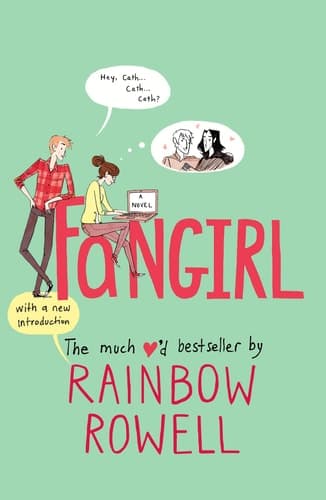
Fangirl A Novel — Content Guide for Parents
Themes present
Not found
Content themes
Factual summary of themes present in this book. No opinion — just the facts.
Get the full theme breakdown in the app
Detailed evidence, confidence ratings, and source citations for every theme.
Download for iOSExample theme card
Religious themes
PRESENTContains references to prayer and church attendance. A minister character plays a supporting role in two chapters.
About this book
With a New Introduction!
In Rainbow Rowell's Fangirl, Cath is a Simon Snow fan. Okay, the whole world is a Simon Snow fan, but for Cath, being a fan is her life—and she's really good at it. She and her twin sister, Wren, ensconced themselves in the Simon Snow series when they were just kids; it's what got them through their mother leaving.
Reading. Rereading. Hanging out in Simon Snow forums, writing Simon Snow fan fiction, dressing up like the characters for every movie premiere.
Cath's sister has mostly grown away from fandom, but Cath can't let go. She doesn't want to.
Now that they're going to college, Wren has told Cath she doesn't want to be roommates. Cath is on her own, completely outside of her comfort zone. She's got a surly roommate with a charming, always-around boyfriend, a fiction-writing professor who thinks fan fiction is the end of the civilized world, a handsome classmate who only wants to talk about words . . . And she can't stop worrying about her dad, who's loving and fragile and has never really been alone.
For Cath, the question is: Can she do this? Can she make it without Wren holding her hand? Is she ready to start living her own life? And does she even want to move on if it means leaving Simon Snow behind?
A New York Times Book Review Notable Children's Book of 2013
A New York Times Best Seller!
Frequently asked questions
Is Fangirl A Novel appropriate for a 7-year-old?
No violence detected in the book. The narrative focuses on themes of fandom, family, and personal growth without any physical confrontations or violent acts. No scary content present in the book. The narrative is described as a charming love story and does not include elements intended to frighten or disturb readers.
Does Fangirl A Novel have violence?
No violence detected in the book. The narrative focuses on themes of fandom, family, and personal growth without any physical confrontations or violent acts.
Does Fangirl A Novel have scary content?
No scary content present in the book. The narrative is described as a charming love story and does not include elements intended to frighten or disturb readers.
Does Fangirl A Novel have religious themes?
No religious content in the book itself. Search results do not indicate any religious practices, beliefs, or ceremonies present in the narrative.
Does Fangirl A Novel have racial/cultural content?
No explicit racial themes or discussions present in the book. The narrative focuses on personal and social themes rather than race as a central element.
Does Fangirl A Novel have profanity?
The book contains strong profanity, including multiple uses of words like 'f--k' and 'bitch'. These instances are noted to be used by a side character and contribute to the overall tone of the narrative.
Does Fangirl A Novel have climate change?
No climate themes or discussions present in the book. The narrative centers around personal growth and fandom rather than environmental issues.
Does Fangirl A Novel have sexual identity?
The book includes discussions of sexual relationships among characters who are over 18, addressing topics like loss of virginity and sexual experiences. There are also references to sexual tension and makeout scenes.
Does Fangirl A Novel have gender roles?
While the protagonist is a female character navigating college life and relationships, the book does not actively discuss or critique gender roles. It focuses more on personal identity and fandom rather than traditional gender expectations.
Does Fangirl A Novel have lgbtq+ themes?
The protagonist, Cath, writes gay fanfiction about two male characters, Simon and Baz, which indicates a presence of LGBTQ+ themes in the narrative. However, the main storyline itself is primarily heterosexual, leading to a mixed representation of LGBTQ+ content.