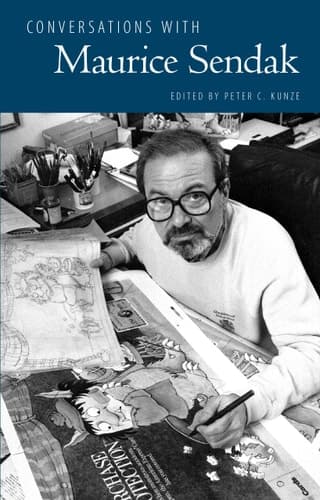
Conversations with Maurice Sendak — Content Guide for Parents
Themes present
Not found
Content themes
Factual summary of themes present in this book. No opinion — just the facts.
Get the full theme breakdown in the app
Detailed evidence, confidence ratings, and source citations for every theme.
Download for iOSExample theme card
Religious themes
PRESENTContains references to prayer and church attendance. A minister character plays a supporting role in two chapters.
About this book
The interviews here, many of which are hard to find or previously unpublished, span from 1966 through 2011. They show not only Sendak's shifting artistic interests, but also changes in how he understood himself and his craft. What emerges is a portrait of an author and an artist who was alternately solemn and playful, congenial and irascible, sophisticated and populist. The man who showed millions of children and adults alike what's cooking in the night kitchen and where the wild things are, Sendak remains an American original who redefined the picture book and changed children's literature - and its readers - forever.
Frequently asked questions
Is Conversations with Maurice Sendak appropriate for a 7-year-old?
Sendak described the process of creating children's books as a 'battleground' and acknowledged the inherent violence in human nature, suggesting a thematic exploration of violence in his discussions, though not necessarily depicted graphically in his works. While Sendak's works often feature fantastical elements that may be perceived as scary, there is no content in the book that would genuinely frighten children. Discussions about his characters do not indicate a focus on genuinely frightening themes.
Does Conversations with Maurice Sendak have violence?
Sendak described the process of creating children's books as a 'battleground' and acknowledged the inherent violence in human nature, suggesting a thematic exploration of violence in his discussions, though not necessarily depicted graphically in his works.
Does Conversations with Maurice Sendak have scary content?
While Sendak's works often feature fantastical elements that may be perceived as scary, there is no content in the book that would genuinely frighten children. Discussions about his characters do not indicate a focus on genuinely frightening themes.
Does Conversations with Maurice Sendak have religious themes?
Maurice Sendak was raised in a Jewish household but identified as an atheist in adulthood, stating that he did not believe in God. He expressed that religion did not hold meaning for him, indicating a critical perspective on religious belief.
Does Conversations with Maurice Sendak have racial/cultural content?
There are no explicit racial themes or discussions in the book. Sendak's works do not center around race as a theme, and the search results do not indicate any relevant content.
Does Conversations with Maurice Sendak have profanity?
Some interviews with Sendak have included exuberant profanity, which he did not shy away from, indicating a candid and unfiltered approach to conversation, though this does not necessarily reflect the content of his children's books.
Does Conversations with Maurice Sendak have climate change?
There are no climate themes present in the book. The search results do not indicate any relevant discussions about environmentalism or climate issues.
Does Conversations with Maurice Sendak have sexual identity?
No explicit sexual content is present in the book. Discussions around Sendak's sexuality pertain to his personal identity rather than sexual themes within the narrative of his works.
Does Conversations with Maurice Sendak have gender roles?
The book does not actively discuss or critique gender roles. While Sendak's works may include diverse characters, there is no thematic focus on gender expectations or roles within the narrative.
Does Conversations with Maurice Sendak have lgbtq+ themes?
Maurice Sendak openly identified as gay, which he discussed in interviews, indicating a personal connection to LGBTQ+ themes. His experiences and identity are reflected in his work and public discussions, contributing to a broader understanding of queer representation in children's literature.