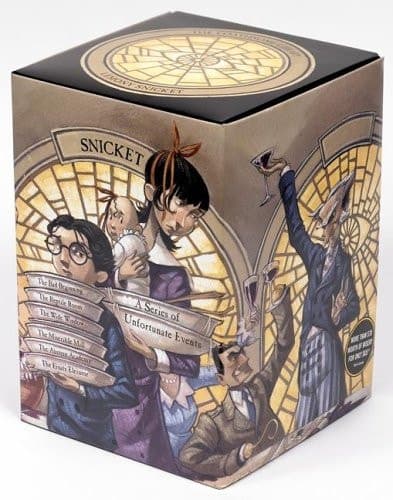
A Series of Unfortunate Events Box: The Loathsome Library (Books 1-6) — Content Guide for Parents
Themes present
Not found
Content themes
Factual summary of themes present in this book. No opinion — just the facts.
Get the full theme breakdown in the app
Detailed evidence, confidence ratings, and source citations for every theme.
Download for iOSExample theme card
Religious themes
PRESENTContains references to prayer and church attendance. A minister character plays a supporting role in two chapters.
About this book
Readers incapable of running fast enough to escape Lemony Snicket's A Series of Unfortunate Events can breathe a sigh of relief now that the first six books of the series have been securely contained in a shrink-wrapped box disguised with exquisite Brett Helquist slip case art that will prevent this collection of woe from falling into the wrong hands.
Frequently asked questions
Is A Series of Unfortunate Events Box: The Loathsome Library (Books 1-6) appropriate for a 7-year-old?
The series contains elements of violence, including perilous situations faced by the Baudelaire orphans, such as encounters with a repulsive villain and a deadly serpent. These themes are consistent throughout the first six books. The series contains dark themes and elements that may be considered scary for younger readers, such as a villainous character and various perilous situations. The tone is described as grim and sinister, which may evoke fear.
Does A Series of Unfortunate Events Box: The Loathsome Library (Books 1-6) have violence?
The series contains elements of violence, including perilous situations faced by the Baudelaire orphans, such as encounters with a repulsive villain and a deadly serpent. These themes are consistent throughout the first six books.
Does A Series of Unfortunate Events Box: The Loathsome Library (Books 1-6) have scary content?
The series contains dark themes and elements that may be considered scary for younger readers, such as a villainous character and various perilous situations. The tone is described as grim and sinister, which may evoke fear.
Does A Series of Unfortunate Events Box: The Loathsome Library (Books 1-6) have religious themes?
No religious content in the book itself. The narrative does not include religious practices, beliefs, or ceremonies.
Does A Series of Unfortunate Events Box: The Loathsome Library (Books 1-6) have racial/cultural content?
No explicit racial themes present in the book. The narrative does not address issues of race or racism as a central theme.
Does A Series of Unfortunate Events Box: The Loathsome Library (Books 1-6) have profanity?
No profanity detected in the book. The language used is appropriate for the target age group and does not include any curse words or strong language.
Does A Series of Unfortunate Events Box: The Loathsome Library (Books 1-6) have climate change?
No climate themes detected in the book. The narrative does not address environmental issues or activism.
Does A Series of Unfortunate Events Box: The Loathsome Library (Books 1-6) have sexual identity?
No sexual content present in the book. The narrative focuses on the misadventures of the Baudelaire orphans without any sexual themes or references.
Does A Series of Unfortunate Events Box: The Loathsome Library (Books 1-6) have gender roles?
The book features brave and intelligent children of both genders but does not actively discuss or critique gender roles. The focus is on the children's adventures rather than on gender dynamics.
Does A Series of Unfortunate Events Box: The Loathsome Library (Books 1-6) have lgbtq+ themes?
No LGBTQ+ themes explicitly present in the book's narrative. While some discussions around characters and interpretations exist, they do not constitute confirmed content in the book itself.