The Way I Used to Be — Content Guide for Parents
Themes present
Not found
Content themes
Factual summary of themes present in this book. No opinion — just the facts.
Get the full theme breakdown in the app
Detailed evidence, confidence ratings, and source citations for every theme.
Download for iOSExample theme card
Religious themes
PRESENTContains references to prayer and church attendance. A minister character plays a supporting role in two chapters.
About this book
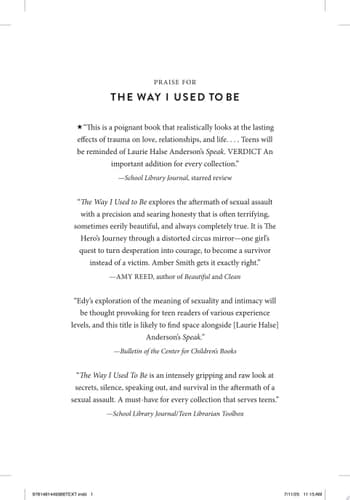
Eden was always good at being good. Starting high school didn’t change who she was. But the night her brother’s best friend rapes her, Eden’s world capsizes.
What was once simple, is now complex. What Eden once loved—who she once loved—she now hates. What she thought she knew to be true, is now lies. Nothing makes sense anymore, and she knows she’s supposed to tell someone what happened but she can’t. So she buries it instead. And she buries the way she used to be.
Told in four parts—freshman, sophomore, junior, and senior year—this provocative debut reveals the deep cuts of trauma. But it also demonstrates one young woman’s strength as she navigates the disappointment and unbearable pains of adolescence, of first love and first heartbreak, of friendships broken and rebuilt, all while learning to embrace the power of survival she never knew she had hidden within her heart.
Frequently asked questions
Is The Way I Used to Be appropriate for a 7-year-old?
The book depicts the brutal rape of the main character, Eden, and explores her subsequent descent into anger and promiscuity. The violence is described as intense and may be distressing for younger readers. The content may be considered scary due to the intense themes of trauma and the aftermath of rape, which could be distressing for sensitive readers.
Does The Way I Used to Be have violence?
The book depicts the brutal rape of the main character, Eden, and explores her subsequent descent into anger and promiscuity. The violence is described as intense and may be distressing for younger readers.
Does The Way I Used to Be have scary content?
The content may be considered scary due to the intense themes of trauma and the aftermath of rape, which could be distressing for sensitive readers.
Does The Way I Used to Be have religious themes?
No religious content or themes are detected in the narrative of 'The Way I Used to Be'.
Does The Way I Used to Be have racial/cultural content?
While there are mentions of diverse characters, race is not a central theme or plot element in 'The Way I Used to Be'.
Does The Way I Used to Be have profanity?
The book contains frequent swearing and name-calling, including strong language such as 'f--k', 's--t', and derogatory terms like 'slut' and 'whore'.
Does The Way I Used to Be have climate change?
No climate-related themes or content are detected in the narrative of 'The Way I Used to Be'.
Does The Way I Used to Be have sexual identity?
The narrative includes descriptions of Eden's sexual encounters and her use of sex as a coping mechanism following her trauma. The sequel also contains references to sexual content, including physical descriptions of sexual acts.
Does The Way I Used to Be have gender roles?
The book does not explicitly address traditional or modern gender roles as a central theme.
Does The Way I Used to Be have lgbtq+ themes?
The author, Amber Smith, is noted as an advocate for LGBTQIA+ equality, and there is a mention of a Black friend in a same-gender relationship in the sequel. However, the specific LGBTQ+ themes in the narrative of 'The Way I Used to Be' are not explicitly detailed in the search results.