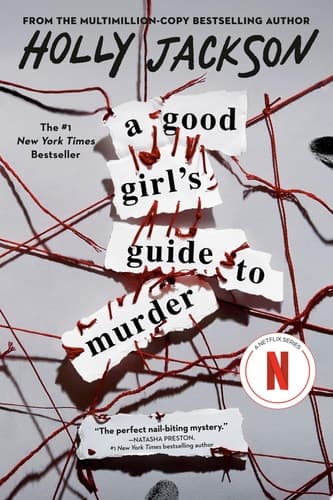
A Good Girl's Guide to Murder — Content Guide for Parents
Themes present
Not found
Content themes
Factual summary of themes present in this book. No opinion — just the facts.
Get the full theme breakdown in the app
Detailed evidence, confidence ratings, and source citations for every theme.
Download for iOSExample theme card
Religious themes
PRESENTContains references to prayer and church attendance. A minister character plays a supporting role in two chapters.
About this book
Everyone in Fairview knows the story.
Pretty and popular high school senior Andie Bell was murdered by her boyfriend, Sal Singh, who then killed himself. It was all anyone could talk about. And five years later, Pip sees how the tragedy still haunts her town.
But she can't shake the feeling that there was more to what happened that day. She knew Sal when she was a child, and he was always so kind to her. How could he possibly have been a killer?
Now a senior herself, Pip decides to reexamine the closed case for her final project, at first just to cast doubt on the original investigation. But soon she discovers a trail of dark secrets that might actually prove Sal innocent . . . and the line between past and present begins to blur. Someone in Fairview doesn't want Pip digging around for answers, and now her own life might be in danger.
And don't miss the sequel, Good Girl, Bad Blood!
"The perfect nail-biting mystery." —Natasha Preston, #1 New York Times bestselling author
Frequently asked questions
Is A Good Girl's Guide to Murder appropriate for a 7-year-old?
The book contains mature themes including violence, with references to drug use, physical assaults, and sexual violence that may not be suitable for younger readers. It is described as a captivating murder mystery that engages with serious themes. The book involves a murder mystery that includes elements of suspense and danger, which may be considered scary for younger audiences. It is categorized as a thriller, indicating a level of intensity that could be frightening.
Does A Good Girl's Guide to Murder have violence?
The book contains mature themes including violence, with references to drug use, physical assaults, and sexual violence that may not be suitable for younger readers. It is described as a captivating murder mystery that engages with serious themes.
Does A Good Girl's Guide to Murder have scary content?
The book involves a murder mystery that includes elements of suspense and danger, which may be considered scary for younger audiences. It is categorized as a thriller, indicating a level of intensity that could be frightening.
Does A Good Girl's Guide to Murder have religious themes?
No religious content or themes are detected in the search results.
Does A Good Girl's Guide to Murder have racial/cultural content?
The narrative features a blended family, including a Black stepdad and stepbrother, and addresses issues of racism through its characters, such as an Indian American teen. This suggests that race and racial dynamics are explored within the story.
Does A Good Girl's Guide to Murder have profanity?
The book includes strong language, with instances of profanity such as 'f--k', 's--t', and 'bitch', indicating that it contains mild to strong language throughout.
Does A Good Girl's Guide to Murder have climate change?
No climate-related themes or activism are detected in the search results.
Does A Good Girl's Guide to Murder have sexual identity?
The narrative includes references to underage drinking, drug use, and instances of sexual violence, including drugging and assault. These elements are significant within the context of the story and are noted as important themes.
Does A Good Girl's Guide to Murder have gender roles?
The protagonist, Pip, is depicted as a strong female character who takes on the role of a detective, challenging traditional gender roles. The narrative includes diverse characters and explores themes of empowerment, but does not explicitly promote modern feminist ideals.
Does A Good Girl's Guide to Murder have lgbtq+ themes?
The book features a queer older sister as a supporting character, indicating the presence of LGBTQ+ themes within the narrative. Additionally, the protagonist, Pip, interacts with diverse characters, including an Indian American teen and her queer sister, suggesting a normalization of LGBTQ+ identities.